

The implementation of Guernsey’s Secondary Pensions framework ceased on 1 October 2025 whereby all employers had to put in place pension arrangements, satisfying the criteria, for all of their employees who fall within the scope of the legislation. During 2025 the minimum joint employer/employee contribution rate was 2% of gross earnings and this increased to 1% employer, 1.5% employee for 2026. Gross earnings are the same earnings on which social security contributions are payable and include basic salary, bonuses, overtime, commissions, and other relevant earnings, subject to the upper earnings limit for each pay period.
Changes for 2027
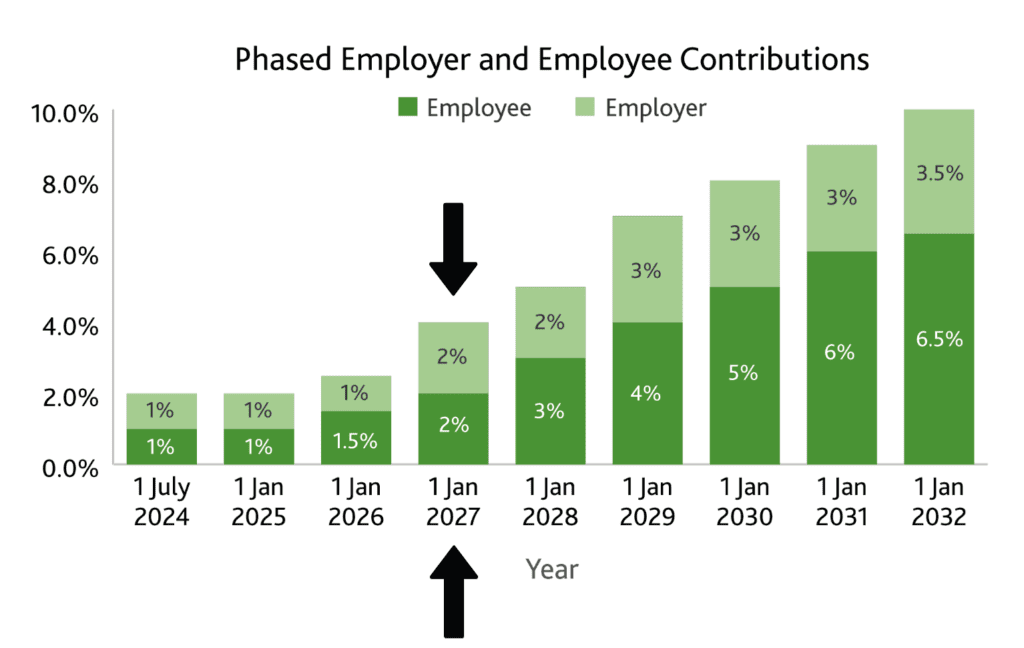
We are now moving into the third phase of the transitional arrangements for secondary pensions. This will see the joint minimum contribution rate increase gradually from 2% to 10% by 2032. The second increase comes into effect on 1 January 2027, with the minimum joint employer/employee contribution rate increasing from 2.5% to 4%.
The nominal split of these minimum contributions is 2% from the employer and 2% from the employee. However, an employer can choose to pay more than 2%, with any additional employer contributions automatically reducing the employee’s minimum contribution.
Secondary Pensions – minimum contribution rates
Things to watch out for going forward
Increases in employers’ contributions
Employers who have only been paying the minimum contribution rate to date will need to take care to ensure that they have updated their processes and procedures to ensure that the joint minimum contribution rate will continue to be met, by increasing both the employee’s and employer’s contribution rate to 2% for 2027. Unlike the employees’ minimum rate, which will increase every year between 2026 and 2032, the employers’ minimum rate only increases every two or three years, so there is a risk that it could be overlooked, when the first rate comes into effect from 1 January 2027.
Employers’ own transitional arrangements
Some employers have opted to pay more than the minimum initial contribution rate, but less than the long-term minimum rate of 10%. In some cases this has been to reduce the initial contribution burden on their employees to encourage pension savings amongst their staff. However, at some point over the next few years, the rate the employer has opted to pay will fall below the minimum joint rate.
For example, if an employer had opted to pay 5% pension contributions from the outset, with no compulsory member contributions, this would satisfy the joint contribution rate up until the end of 2028. However, from 1 January 2029 either the employee would need to start contributing, or the employer would need increase their contribution rate by 2%.