
“we have seen a 41% reduction between 2021 and 2025.”
Three years ago we reported the initial steps on our journey to meet our climate pledge of achieving Net Zero Greenhouse Gas Emissions by 2030. Adoption of sustainability principles remains central to all aspects of our operations and we have been engaging with the whole team to turn our Net Zero pledge into a reality.
We needed to measure our carbon footprint accurately so that we could monitor our progress in reducing it. We engaged an independent consultant to provide an initial assessment and measure each subsequent year’s activity. We chose 2019 as our base year – the latest year that was not impacted by Covid-related disruptions; we have measured our footprint each year since 2021 on a consistent basis.
We have looked at all Scope 1 (Direct) emissions and Scope 2 (Purchased) emissions, and as many Scope 3 (Supply Chain) emissions as can be reliably measured. In particular, within Scope 3, business travel, staff commuting, homeworking, water usage and waste disposal were measured and included within the assessment of the carbon footprint. No reliable data for other elements of the supply chain have been available, but this remains under review and will be included in future years’ assessments when it is feasible to do so.
Progress to Date
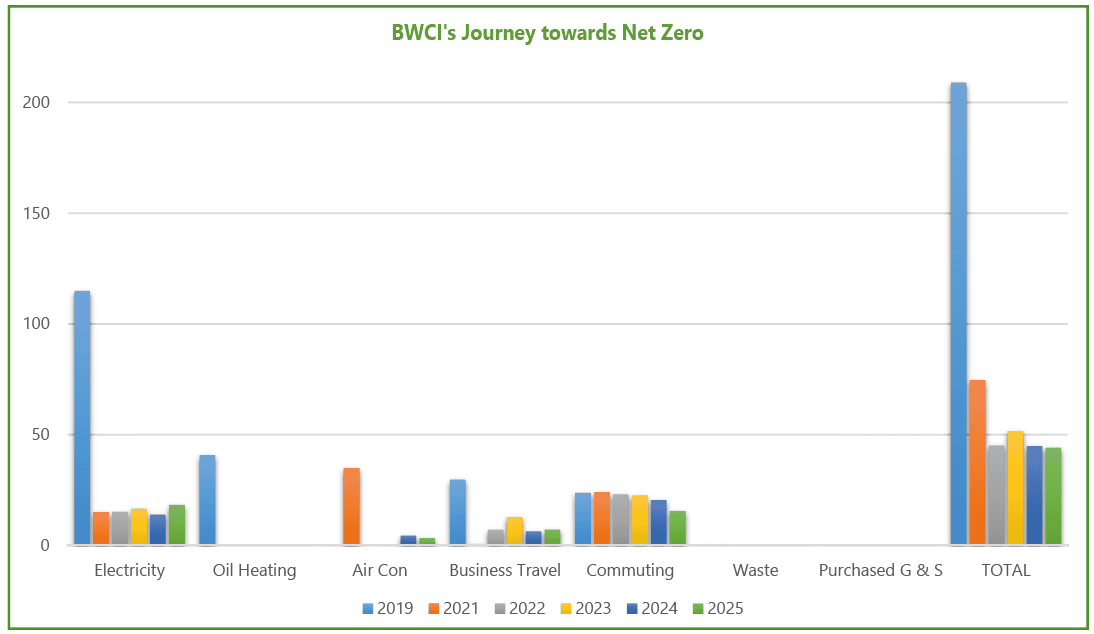
Through a combination of actions which we have taken, and due to some factors beyond our control, we have seen our measured Carbon Footprint reduce by 79% between 2019 and 2025 as shown in the chart below. Since we last reported, we have seen a 41% reduction between 2021 and 2025. This has been principally for four reasons:
- We persuaded the landlord of our Guernsey Office to replace the old oil-based heating and cooling system with a more efficient electric system.
- Guernsey’s undersea electric supply cable with France has been repaired so that the electricity supply has largely been coming from French “clean” energy sources rather than from on Island diesel generators.
- Since the Covid-related disruptions, most business meetings have become virtual, so that business travel is now at much lower levels than previously.
- Our campaign to encourage active travel for staff commuting has resulted in a meaningful reduction in the carbon footprint of commuting to and from work.
While we cannot eliminate our carbon footprint entirely, we have purchased carbon offsets which have effectively reduced our net carbon footprint to zero since 2022. We will continue with this policy, running in parallel with our other carbon reduction initiatives.
Helping our Clients
As well as aiming to run our own business sustainably, we have also engaged with our clients to assist them to consider Environmental, Social and Governance (“ESG”) issues and hence have an indirect impact in promoting measures to reduce the effect of climate change. How pension plans are invested has an important role to play and widely quoted research by makemymoneymatter.co.uk suggests that:
“Greening our pensions cuts our carbon footprint 21x more than going veggie, giving up flying and switching energy providers.”
We have taken this on board with our own Blue Riband fund range with ESG funds adopted as the default funds. In addition, the Blue Riband product has adhered to the ESG Framework for Pensions published by the Guernsey Association of Pension Providers.
Demand for ESG funds continues to increase and is an important part of or investment team’s strategic advice. For more information about the options, please contact any of our investment consultants.
BWCIs Progress towards Net Zero